

To further advance Southeast University’s strategic initiative of the SEU Year of Global Engagement, the 2026 “Following Marx” Program, organized by the School of Marxism at Southeast University, was successfully held in Germany from July 31 to August 7, 2026.
The program began in Brussels, Belgium, and took the delegation through Trier, Cologne, Essen, and Wuppertal before concluding in Berlin. Over the course of eight days and across six cities, faculty and students retraced the footsteps of Marx and Engels, visited important historical sites, and engaged in academic exchanges with scholars and institutions in Germany.
I. Tracing Marx’s Origins: Rediscovering the Origins of Marxist Thought
The first stop of the program was Brussels, the capital of Belgium. The delegation visited the Swan Café on Brussels’ Grand-Place, where The Communist Manifesto was written. Standing in the historic square, the faculty and students reflected together on the remarkable history of Marx and Engels’ shared intellectual and revolutionary endeavors.
Leaving Brussels, the delegation arrived in Trier, the birthplace of Karl Marx. At the Karl Marx House, the delegation viewed a collection of valuable historical materials, including photographs of Marx’s parents, his birth certificate, and his secondary-school graduation certificate. The third floor features a number of particularly significant historical documents and publications, including the first edition of The Communist Manifesto, the first edition of Capital, books presented by Marx and Engels bearing their signatures, and handwritten letters.
II. Following Marx’s Footsteps: Revolutionary Cologne and the Industrial Ruhr
The delegation next traveled to central Cologne, where the former editorial office of the Neue Rheinische Zeitung was located. Following the outbreak of the European revolutions in 1848, Marx and Engels returned from Paris to Cologne and founded the Neue Rheinische Zeitung on June 1, 1848, with Marx serving as its editor-in-chief.
At the University of Cologne, the delegation engaged in in-depth academic exchanges with experts and scholars from the Universities Alliance of North Rhine-Westphalia.
The delegation then visited the Zollverein Coal Mine Industrial Complex in Essen. Once one of Europe’s largest coal-mining complexes, Zollverein ceased operations in 1986 and was inscribed on the UNESCO World Heritage List in 2001. Today, the complex houses collections centered on the natural and cultural history of the Ruhr region, covering fields including geology, archaeology, history, and photography.
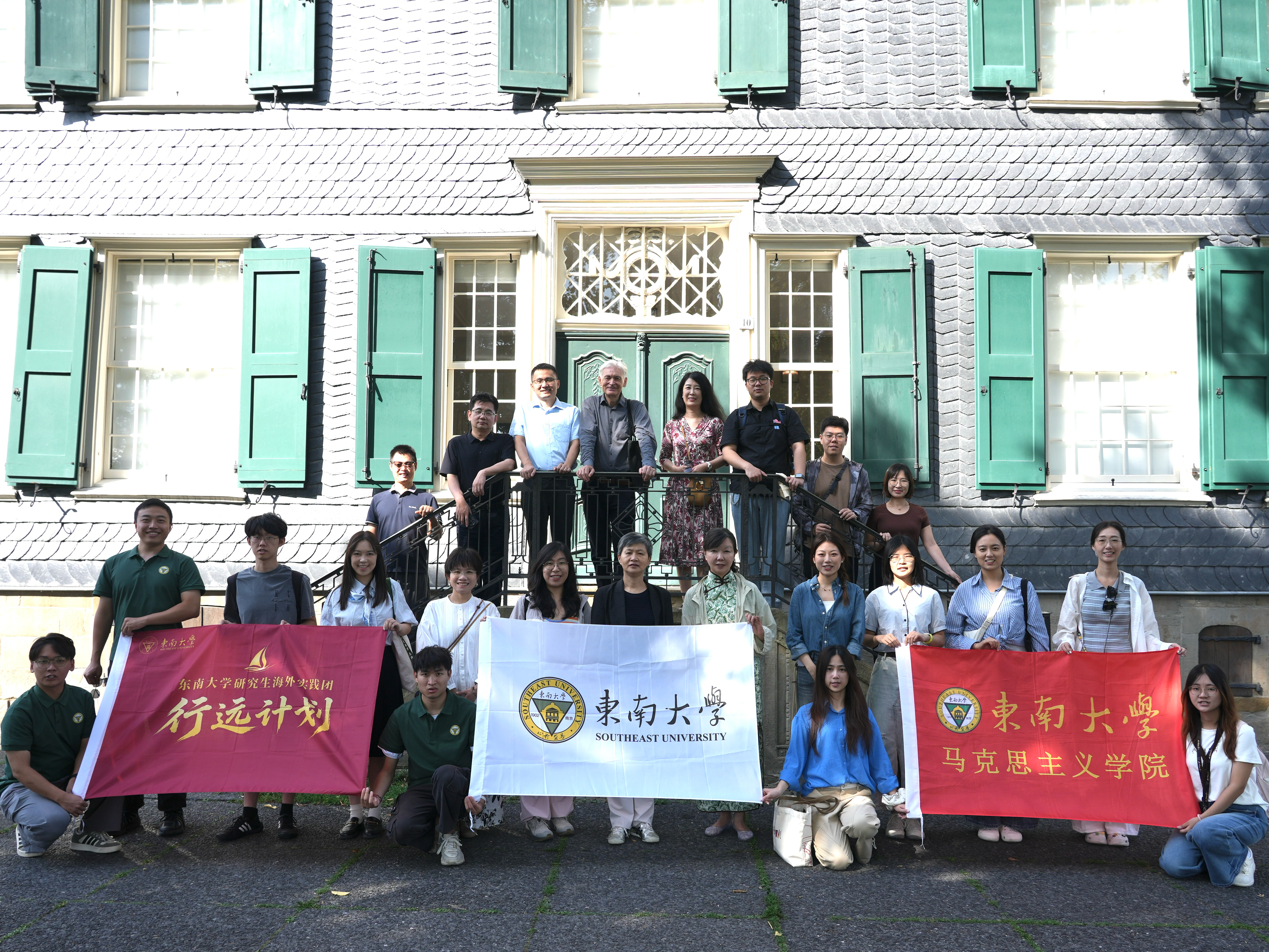
The delegation subsequently traveled to 10 Engelsstraße in Barmen, Wuppertal. Built in 1775, this four-story Baroque building was the ancestral home of the Engels family and the principal residence of Friedrich Engels during his youth. The second floor houses an exhibition featuring letters Engels wrote to his parents during his youth, plays he wrote while attending secondary school, as well as important documents and photographic materials from throughout his life. The exhibition offers a comprehensive account of Engels’ life and intellectual development.
III. Engaging with Marxist Theory: Deepening Understanding through Academic Dialogue
Following the visit to the Engels House, the delegation engaged in an in-depth academic dialogue with Professor Smail Rapic of the University of Wuppertal. In his lecture, “Karl Marx and Max Weber’s Analyses of Money in Modern Capitalism,” Professor Rapic systematically examined Marx’s analyses of money and capital, providing the delegation with a deeper understanding of the development of Marxist political economy.
The delegation then arrived at Humboldt University of Berlin, one of the world’s renowned institutions of higher education, founded in 1810. Marx studied law and philosophy there from 1836 to 1841.
Upon entering the main building, the delegation saw a famous passage from Marx’s Theses on Feuerbach engraved on the marble wall opposite the staircase: “The philosophers have only interpreted the world, in various ways; the point, however, is to change it.”
At Humboldt University, the delegation engaged in academic exchanges with Professor Rolf Hecker and Professor Andreas Arndt. Professor Hecker provided a systematic introduction to the editorial progress and scholarly significance of the Marx-Engels-Gesamtausgabe (MEGA²).
Professor Arndt discussed the issue of poverty in Hegel’s theory of civil society, offering an in-depth analysis of its theoretical and historical dimensions.
IV. Understanding the Present through Marx: Connecting History and Contemporary China
The final stop of the program was the Rosa Luxemburg Foundation in Berlin. Nadja Charaby introduced the delegation to the Foundation, explaining that it was established in 1990 and serves as a political education institution and center for critical intellectual research associated with Die Linke (The Left) in Germany.
During the seminar, Professor Ingar Solty explored the dissemination and evolution of Marxism, examining how Marxist thought has developed and transformed across different historical and social contexts.
Professor Michael Brie shared his personal experiences and reflections on his commitment to Marxism, offering the delegation an insightful perspective on the relationship between intellectual conviction and Marxist thought.
Conclusion: Carrying the Torch of Ideas Forward
From Brussels to Trier, and from Cologne to Berlin, this eight-day journey across six cities enabled the faculty and students of the School of Marxism at Southeast University to encounter the intellectual legacy of Marx and Engels at historical sites and to engage in dialogue with contemporary scholarship at the forefront of Marxist studies.
The program has provided a new starting point for the faculty and students of the School of Marxism at Southeast University. They will transform their profound experiences and insights gained at these historical sites into renewed momentum for academic research, uphold the university motto “Strive for Perfection,” and respond to the university’s strategic initiative for global recognition.


